TYPES OF FLOOR SLABS
Floating | supported by the ground and independent of perimeter foundations |
Supported | The slab is supported on the foundation |
Monolithic | the slab is an integral part of the footings |
Structural | Self Supporting concrete slabs; precast or cast in place |
FOOTING AND FOUNDATION TYPES
Strip /Spread Footings | footings around the foundation perimeter walls |
Pilaster | thickening of a foundation wall either to receive concentrated loads from above OR to prevent a wall from bowing |
Pad Footings | footings usually under a single pier or column |
Piles | used instead of footings where soil quality is poor |
Piers | columns that may be concealed in the soil or may project above it. |
Grade Beam | concrete beam supporton on pile/pier/footings usually located at grade level |
Caissons | foundation systems created by dilling holes and filling them with concrete |

Vertical cracks → differential settlement
Horizontal cracks → serious problem
Floor joists perpendicular to foundation walls provide good lateral support. Parallel joists need blocking to provide lateral support from several joists.
cinder block is weaker than concrete block
Cold joints = result of pouring a foundation at two separate times
Honeycombing j= large voids or bubbles in poured concrete walls
FLOORS
Strength = how much load can be applied before something breaks
Stiffness = how much bending or deflection takes place with a given load
In some jurisdictions, the max deflection allowed is 1/360th * lenght of joist
JOIST/BEAM POCKETS - there should be 1/2 inch gap between beams and concrete wall to allow circulation. IF EMBEDDED, the wood must be pressure treated.
SILLS
A sill is a wooden or metal beam that connects the foundation wall to the floor system above. These may be 2 X4, 2X6 or 2X8 lumber (typically same species and grade as the rest of the house’s lumber). Sills are usually separated from the foundation wall by a SILL GASKET. A sill gasket is a compressible material designed to stop air leakage and separate the sill from the concrete.

CRAWLSPACES
The earth in subgrade areas should be at least 18 inches below floor joists and 12 inches below beams.
- There is a chance of rot if there is less than 1 Sf of ventilation for 150SF of floor area
COLUMNS
Wood columns should be at least 4 X 4 inches. Steel columns should be at least 3 inches in diameter.
Built-up wood columns should be bolted together with two bolts every 16 inches or nailed together with two nails every 12 inches.
Hollow masonry columns should be at least 12 by 12 inches OR 10 by 16 inches. Round concrete columns should be 9 inches in diameter minimum and square concrete columns should be 8 X 8 inches minimum.
The width of a built-up wood column should be the same as the width of the beam that it supports.
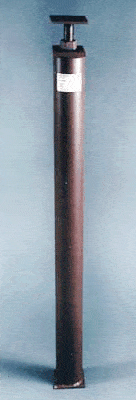
TEMPORARY COLUMNS USED PERMANENTLY
- Two - Types: Single Piece and Telescoping


- In the US, only single piece columns 3 inches or greater in diameter may be used as permanent support AND they must be manufactured with ASTM A 53 Grade B or an approved equivalent.
When inspecting, assume that nay adjustable steel column is being used permanently BUT check that is is the correct type. It must have a label referencing ICC-ES or BOCA report. IT MUST BE A SINGLE PIECE COLUMN OF AT LEAST 3 INCHES OF DIAMETER.

Beams (Girders)
Beam carry the floor loads from floors, walls, roofs, etc to the foundation walls.
Beams require 3 inches of solid bearing at each support point if resting on concrete or masonry and 1 1/2 if resting on wood or metal. Bearing should be full width of the beam to avoid crushing or rotation.
BEAMS SHOULD NOT BE NOTCHED OR CONTAIN DRILLED HOLES!
- Beams may be built-up of 2 inch dimensional lumber. These should be nailed or bolted together about every 18 inches along the length of the beam.